
Introduction to Industrial Puzzle Making Machines
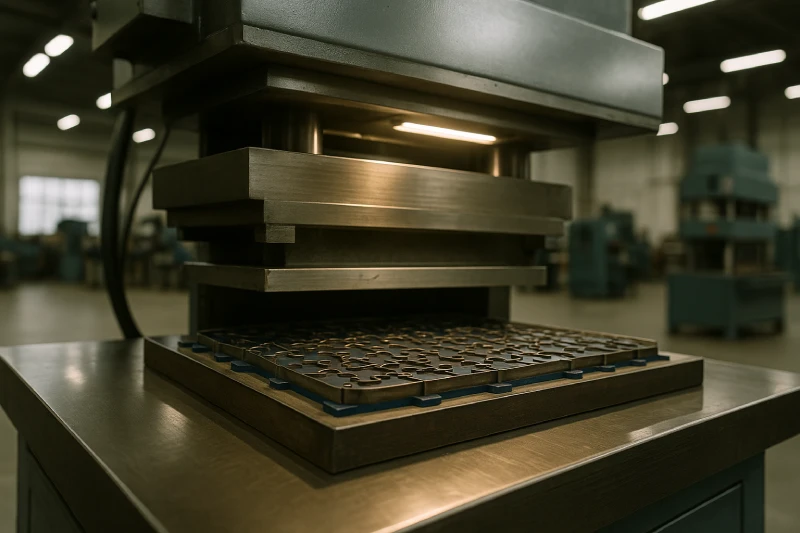
A puzzle making machine is a specialized hydraulic cutting system designed to convert laminated printed sheets into precisely cut jigsaw puzzles for commercial production. Unlike small hobby tools, industrial-grade puzzle presses are built to deliver consistent cutting pressure, high throughput, and long-term operational stability—key requirements for factories supplying export-grade puzzles to global markets.
In a modern manufacturing environment, accuracy and efficiency directly influence puzzle quality and profitability. As puzzle demand has expanded across education, entertainment, promotional merchandise, and premium gift packaging, manufacturers increasingly rely on automated or semi-automated puzzle cutting equipment to maintain competitive output. Traditional manual die-cutting methods cannot ensure the pressure uniformity, blade penetration depth, or cycle-time efficiency needed for large-scale production.
Industrial puzzle making machines integrate a rigid steel frame, a high-tonnage hydraulic press, precision-ground platens, and custom steel-rule dies to produce clean, fiber-free cuts. When paired with stable lamination equipment and controlled feeding systems, these machines enable continuous 24/7 manufacturing with minimal waste and highly repeatable accuracy.
For factories planning capacity expansion, product diversification, or quality upgrades, understanding the structure and working principle of a puzzle making machine is essential before selecting the right equipment configuration. The following sections explain how these machines are engineered, how they operate, and where they are best applied in a puzzle production line.
Core Structure of a Puzzle Making Machine
An industrial puzzle making machine is engineered to deliver stable cutting force, high accuracy, and long-term durability under continuous production. Its structure consists of four core assemblies: the hydraulic frame, the steel-rule die, the worktable/feeding system, and the electrical control system. Each component directly affects cutting precision, cycle time, and maintenance cost.
Hydraulic Frame & Pressing Unit
The hydraulic frame forms the backbone of the entire press. Heavy-duty welded steel construction minimizes deformation during high-tonnage operation, while precision-machined upper and lower platens ensure uniform pressure distribution across the puzzle sheet. The hydraulic cylinder—typically single or double acting—generates the downward cutting force, with tonnage options ranging from 100 to 500 tons depending on puzzle size, die blade length, and sheet thickness. Pressure sensors and proportional valves stabilize the working force, preventing partial cuts and extending die service life. A rigid frame and accurate platen parallelism are essential for mass-production puzzle factories where consistency is non-negotiable.
Cutting Die (Steel-Rule Die)
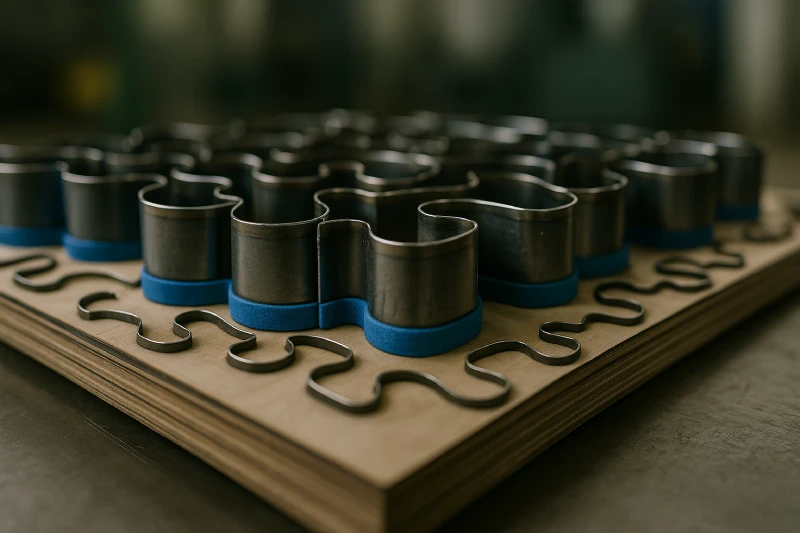
The steel-rule die is the core cutting tool responsible for creating the puzzle’s random-cut geometry. It consists of a high-density plywood die board, CNC-cut blade slots, and hardened steel blades bent to precise radii. Blade height typically ranges from 23.8 to 25.4 mm depending on the substrate. Blueboard or ejection rubber is added around the blade to compress during cutting and expand upon release, ensuring clean ejection of the puzzle sheet. High-quality die material directly affects edge sharpness, cutting depth stability, and the machine’s achievable production rate. Dies can be customized for 300–2000-piece puzzles, children’s puzzles, irregular shapes, and OEM designs.
Worktable & Feeding Mechanism
The worktable supports the die and puzzle sheet, with alignment pins or side guides used to position each laminated sheet accurately. Depending on automation level, feeding may be manual, semi-automatic, or fully automatic with conveyor integration. Reinforced safety features—such as light curtains, two-hand controls, and interlocking guards—ensure operator safety during high-tonnage cutting.
Electrical & Control System
A PLC-based control system manages cutting pressure, stroke depth, dwell time, and cycle frequency. Operators can adjust settings for different materials and die types, enabling stable performance across diverse production requirements. Safety relays, overload protection, and CE-compliant wiring ensure reliable, trouble-free operation under continuous use.
Working Principle: Step-by-Step Cutting Process
The working principle of a puzzle making machine is based on controlled hydraulic pressure driving a steel-rule die through a laminated puzzle sheet to produce clean, consistent cuts. The process involves several coordinated stages designed to maintain accuracy, minimize waste, and ensure stable mass-production performance.
1. Printed Sheet Lamination
Before die-cutting, the printed artwork is bonded to a cardboard substrate using industrial laminating equipment. Adhesive type, glue uniformity, and drying time directly influence sheet flatness. A stable lamination process ensures the compressed layers behave as a single rigid sheet during cutting, preventing blade drag, fiber tearing, or inconsistent penetration.
2. Die Positioning on the Worktable
The steel-rule die is secured onto the worktable using mechanical locks or magnetic plates. Alignment accuracy, usually within ±0.1–0.2 mm, ensures each sheet lands in the correct position relative to the cut pattern. Proper seating of the die also protects the plywood board and steel blades from premature wear.
3. Hydraulic Press Activation
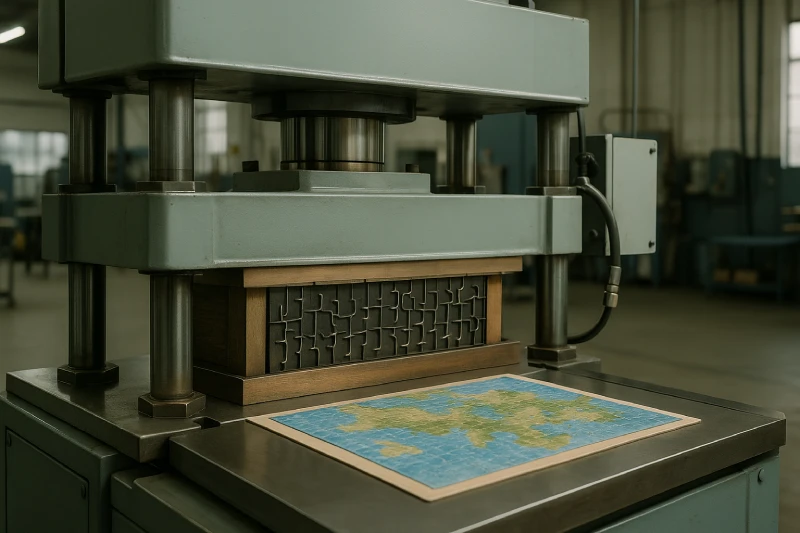
When activated, the hydraulic cylinder drives the upper platen downward at a controlled speed. The machine applies a precise tonnage level—calculated based on puzzle size, die blade perimeter length, and board thickness—to fully penetrate the laminated sheet. PLC-regulated pressure ensures that the entire sheet receives uniform force, eliminating partial cuts and maintaining high repeatability across long production runs.
4. Steel Rule Blades Penetrate the Sheet
As the platen reaches its set stroke depth, the sharpened steel blades cut through the cardboard and paper layers along the random-cut pattern. Proper blade height, hardness, and die board stiffness are critical for achieving clean edges without fraying. High-quality blades also reduce the required cutting force and extend operating lifespan.
5. Ejection and Sheet Removal
When the press retracts, the ejection rubber compresses and releases, lifting the freshly cut puzzle sheet upward. This prevents sticking and ensures smooth removal. A well-calibrated ejection system reduces downtime and prevents sheet deformation.
6. Post-Cut Handling
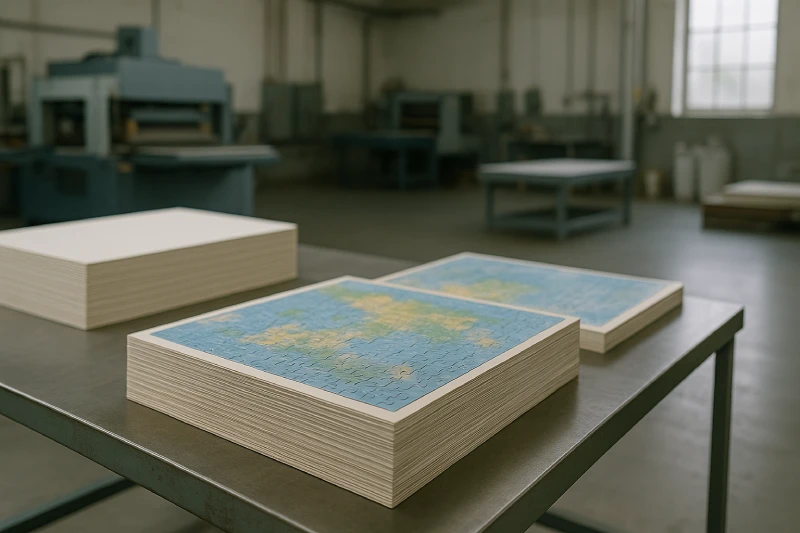
After cutting, the puzzle sheet is transferred for separation, piece sorting, and quality inspection. Factories may use manual separation tables or automated shakers depending on production capacity. Consistent cut quality reduces scrap rates and enhances downstream packaging efficiency.
Types of Puzzle Making Machines
Puzzle making machines are available in multiple configurations to support different scales of production, operator skill levels, and automation requirements. Selecting the appropriate machine type helps manufacturers balance investment cost, throughput, and long-term operational stability.
Manual Puzzle Press
A manual puzzle press is the most basic and cost-efficient option, typically used by small studios or low-volume producers. Operators manually position each laminated sheet and activate the press with a two-hand control system. Manual presses generally operate within the 50–80 ton range and are suitable for short production runs or prototype samples. While investment cost is low, cycle time is slower, and cutting consistency depends heavily on operator accuracy. This option is not recommended for factories targeting continuous or large-scale puzzle production.
Semi-Automatic Hydraulic Puzzle Press
Semi-automatic hydraulic presses represent the industry standard for mid- to high-volume puzzle factories. These machines incorporate a stronger welded frame, 150–500 ton hydraulic systems, and precision-machined platens to produce stable, repeatable cuts. Semi-automatic presses offer mechanical or pneumatic sheet positioning, optional automatic die clamping, and enhanced safety features such as light curtains. Their balance of affordability, speed, and reliability makes them the most widely adopted solution among export-oriented puzzle manufacturers. Cycle time typically ranges from 5–10 seconds per sheet depending on puzzle size and die complexity.
Fully Automatic Puzzle Cutting Line
A fully automatic line integrates auto-feeding, auto-cutting, and auto-stacking to support 24/7 mass production with minimal labor. These systems are designed for large puzzle factories producing tens of thousands of puzzles per day. Features may include servo-controlled sheet alignment, conveyor-based feeding, intelligent pressure adjustment, and automated scrap removal. Beyond boosting throughput, full automation significantly reduces handling errors and ensures consistent quality across long production batches. Although initial investment is higher, the return on productivity, labor savings, and waste reduction makes it the preferred option for high-capacity manufacturers.
Key Engineering Features That Determine Cutting Quality
Cutting quality is the single most important metric for evaluating a puzzle making machine. The precision of each jigsaw piece depends on the machine’s structural rigidity, hydraulic performance, die configuration, and material preparation. Several engineering factors directly influence edge smoothness, penetration uniformity, and long-term production stability.
Cutting Pressure & Uniformity
The relationship between hydraulic pressure and blade penetration is fundamental. A puzzle press must deliver consistent force across the entire platen surface, especially for full-size 500- to 2000-piece dies that require longer cutting perimeter. Insufficient or uneven pressure results in partial cuts, while excessive tonnage accelerates die wear. High-quality presses use oversized cylinders, proportional valves, and pressure sensors to maintain uniformity throughout every stroke.
Platen Flatness & Parallelism
Platen accuracy determines whether all blades enter the laminated sheet at identical depth. Deviations in flatness or parallelism cause localized under-cutting or over-cutting, increasing scrap rates and rework time. Industrial-grade machines maintain platen flatness within ±0.1 mm and enforce strict alignment tolerance through precision machining and reinforced frame design.
Die Board Material & Steel Rule Blade Height
A high-density plywood die board provides the rigidity needed to hold steel blades securely under high tonnage. Blade height—commonly 23.8, 25.0, or 25.4 mm—must match the cardboard thickness and machine stroke settings. Premium hardened blades reduce friction, improve random-cut definition, and extend maintenance intervals. Inferior dies lead to inconsistent edge quality regardless of machine tonnage.
Lamination Flatness
Even the best press cannot compensate for warped or uneven laminated sheets. Glue distribution, curing conditions, and cardboard density must remain stable to ensure uniform resistance during cutting. Flat, properly bonded sheets produce cleaner cuts and lower blade stress.
Compatible Materials & Puzzle Specifications
Industrial puzzle making machines are engineered to handle a wide range of materials and puzzle formats used by commercial manufacturers. Their structural rigidity, hydraulic tonnage, and die compatibility determine which substrates can be processed efficiently and with consistent quality.
Cardboard Thickness (1.5–2.5 mm)
The most common material for jigsaw puzzles is laminated greyboard within the 1.5–2.5 mm range. This thickness provides the optimal balance between durability, flexibility, and cutting resistance. Puzzle presses must deliver adequate tonnage to penetrate this density while maintaining clean, burr-free edges.
Special Materials
Beyond standard cardboard, many factories produce specialty puzzles for premium markets. These may include wooden puzzles, MDF puzzles, magnetic puzzles, and plastic puzzles. Each material requires adjusted stroke settings, specialized steel-rule blade hardness, or higher cutting force. High-tonnage hydraulic systems and customizable dies allow manufacturers to diversify product lines without replacing core equipment.
Die Compatibility
Puzzle making machines support a wide range of steel-rule dies, from 300-piece children’s puzzles to 1000- and 2000-piece random-cut layouts. Custom dies can be produced for irregular shapes, branded promotional puzzles, oversized formats, or multi-sheet cutting. The machine’s platen size and clamping system determine the maximum die dimensions it can accommodate.
Industrial Applications & Production Scenarios
Industrial puzzle making machines are deployed across multiple manufacturing environments where high-volume, high-consistency cutting is required. Their ability to support continuous operation and diverse substrate compatibility makes them essential equipment for professional jigsaw production.
Mass-Production Puzzle Factories
Large puzzle manufacturers rely on hydraulic puzzle presses as the core cutting station within a full puzzle production line. These factories typically operate 24/7 and require machines capable of maintaining stability across thousands of cycles per day. High-throughput presses reduce labor cost, minimize scrap rates, and ensure uniform quality—critical for export-grade puzzles sold in global markets.
Printing & Packaging Companies
Many commercial printers and packaging plants add puzzle cutting machines as a value-added production module. With minimal integration requirements, a hydraulic puzzle press allows them to convert existing laminated prints into puzzles, expanding service offerings for marketing agencies, publishers, and custom gift suppliers.
Toy Manufacturers
Toy factories incorporate puzzle cutting as part of broader educational and children’s product lines. Machines that support multiple die formats, small batch projects, and fast die-change features enable efficient switching between different puzzle SKUs and seasonal designs.
How to Select the Right Puzzle Making Machine
Selecting the right puzzle making machine requires a clear understanding of production scale, material specifications, die format, and desired automation level. The optimal configuration ensures stable daily output, low scrap rate, and long-term manufacturing efficiency.
Production Volume Requirements
Your expected daily puzzle output determines the necessary machine type. Small or medium-volume factories typically choose semi-automatic hydraulic presses with 150–300 tons of force, offering a balance of speed and affordability. Large-scale manufacturers producing tens of thousands of puzzles per day require fully automatic cutting lines with integrated feeding, cutting, and stacking to minimize labor and downtime.
Cutting Size Range
Machine platen size must match the die dimensions used for standard puzzle formats—commonly 500-, 1000-, and 2000-piece layouts. Larger platen sizes accommodate oversized puzzles or multi-up cutting. Ensuring compatibility with current and future die sizes avoids costly equipment upgrades later.
Automation Needs
Automation level directly affects cycle time and labor demand. Manual feeding may be sufficient for small studios, while semi-automatic presses improve alignment accuracy and safety. Full automation is ideal for manufacturers aiming to achieve continuous 24/7 production with minimal operator involvement.
After-Sales, Die Supply & Spare Parts
Reliable supplier support is essential for uptime. Factories should evaluate the availability of steel-rule dies, die resharpening services, hydraulic seals, cylinders, pumps, and electrical components. A supplier offering fast-response technical support and long-term parts availability ensures lower operating costs and reduced production interruptions.
Cost Considerations & ROI for Manufacturers
Evaluating the investment in a puzzle making machine requires understanding not only the initial purchase price but also the long-term operational and economic benefits it delivers. For most factories, the real value lies in lower scrap rates, increased throughput, and reduced labor dependency.
Machine Price Range
Puzzle making machines vary widely in cost depending on tonnage, platen size, automation level, and custom options. Manual presses represent the lowest investment, while semi-automatic hydraulic presses fall into a mid-range price category. Fully automated cutting lines command higher upfront cost but significantly outperform manual systems in long-term efficiency.
Scrap Rate Reduction & Efficiency Gains
A precision-engineered press with stable hydraulic control dramatically reduces cutting defects such as partial cuts, fiber tearing, and misalignment. Lower scrap rates mean greater usable output per sheet and reduced material waste. Faster cycle times and predictable performance further enhance total daily productivity, improving margins for high-volume manufacturers.
Labor Savings & Safety Improvements
Automation directly reduces the number of operators required per shift. Semi-automatic and fully automatic presses minimize manual handling and significantly enhance workplace safety through integrated guards, sensors, and controlled feeding systems. Over the lifespan of the equipment, labor savings often exceed the initial purchase price, resulting in a strong return on investment.
Why Choose a Professional Puzzle Machine Supplier
Choosing the right supplier is as important as selecting the machine itself. A professional manufacturer provides not only equipment but also the engineering expertise, customization options, and long-term support necessary for stable puzzle production. Since puzzle cutting involves precise hydraulic performance and high-quality steel-rule dies, working with an experienced supplier ensures consistent results throughout the lifetime of the production line.
Engineering Expertise
A competent supplier can recommend the proper tonnage, platen size, and die specifications based on your product portfolio. Their understanding of lamination, die structure, and substrate behavior allows them to optimize machine configuration for clean and consistent cuts.
Stable Hydraulic System
Professional suppliers use high-quality cylinders, pumps, and valves to maintain precise cutting pressure. Stable hydraulic control reduces scrap rates, protects dies from premature wear, and supports long-duration 24/7 manufacturing.
Support for Complete Puzzle Production Lines
Beyond cutting machines, top-tier suppliers can provide lamination units, stacking systems, packaging equipment, and integration services. This ensures smooth workflow coordination and reduces compatibility issues.
Customization & OEM Services
Voltage customization, platen enlargement, pressure adjustment, die-locking systems, and automation upgrades allow factories to scale production as demand increases.
Conclusion
A puzzle making machine is a mission-critical asset for any factory producing jigsaw puzzles at commercial scale. Its cutting precision, hydraulic stability, and die compatibility directly determine product quality and production efficiency. By understanding the machine’s structure, working principle, and application scenarios, manufacturers can make informed decisions that improve output, reduce waste, and support long-term business growth.
Whether you are upgrading an existing production line or planning a new puzzle manufacturing facility, choosing a reliable equipment supplier ensures consistent performance and minimized downtime.
For technical specifications, machine quotations, or customization requests, contact our engineering team to discuss the optimal puzzle cutting solution for your production goals.