
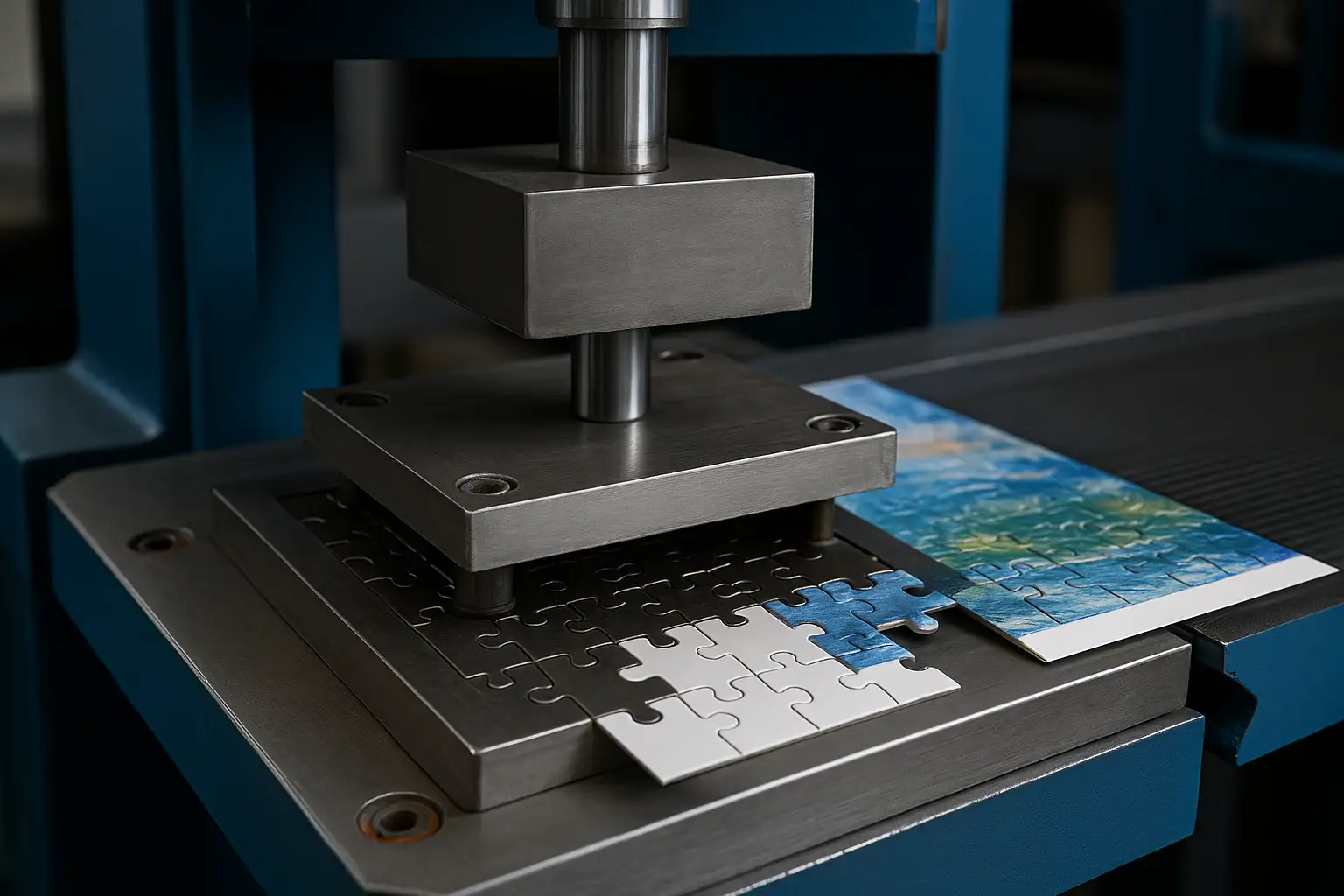
Let’s kill the nuance upfront: for 80% of puzzle factories, die-cutting is the correct answer. Laser cutting is a niche tool, not a replacement. The real question isn’t which is “better”—it’s which one stops you from losing money on your specific order mix.
Die-cutting wins on cost and speed, period
A rotary or flatbed die press runs at 60–100 strokes per minute. Each stroke gives you a fully formed sheet of interlocking pieces. Once your die is made (3–5 days, $400–$1,800 depending on piece count), your marginal cost drops to under $0.10 per sheet for standard 1,000-piece puzzles. No laser on the market touches that throughput. More importantly, die-cutting leaves a clean, beveled edge that fits tight without white dusting—critical if you’re supplying mass retail where returns due to loose fits kill margins.
The catch: die changes are expensive and slow. Every new puzzle design means a new die. If your client wants a one-off run of 200 units for a corporate event, that die cost eats your entire profit. So die-cutting only makes sense if your average batch size stays above 3,000 sheets. Below that, you’re subsidizing tooling, not manufacturing.
Laser cutting solves a problem most factories don’t have
Yes, laser gives you zero tooling cost and five-minute file changes. Yes, you can cut intricate organic shapes that a steel rule die can’t handle. But here’s what machine salespeople won’t tell you: laser cutting speed maxes out at 20–30 sheets per hour on 2mm chipboard. That’s 3–5% of a die line’s output. Your labor cost per sheet triples. Your electricity bill doubles. And you’ll spend 20% of runtime cleaning lenses and adjusting focal height because board density varies batch to batch.
Worse—the burn edge. On white-core or blue-core puzzle board, laser leaves a visible dark rim. Some boutique brands market this as “handcrafted.” Most retail buyers reject it as defective. If your factory supplies Target or Walmart, laser is non-negotiable—you simply cannot pass their visual inspection.
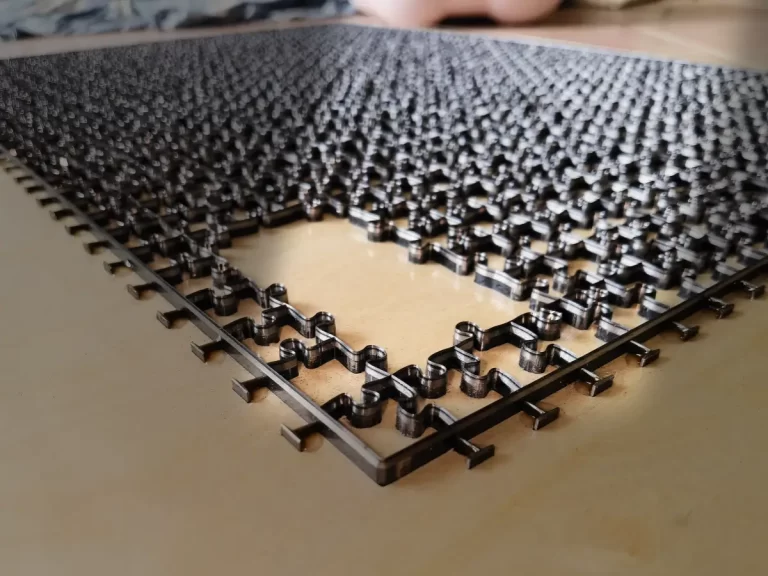
Where laser actually earns its floor space?
Prototyping. Sample requests. Short-run personalized puzzles (names, dates, custom cut lines) for D2C channels. And wood puzzles—laser cuts 4–6mm birch ply beautifully, while die-cutting wood requires expensive forged dies that wear out in 10,000 strokes. If your factory does less than 20% of volume in these categories, buy one laser station, not three. Use it for pre-production samples to validate fit before committing to a physical die. That alone saves you 2–3 scrapped dies per year, which pays for the machine in 18 months.
Our rule at the shop floor
Over 5,000 sheets per design → die-cut. No debate.
500–5,000 sheets → run the numbers. Die amortization often still wins if you expect reorders.
Under 500 sheets or wood/acrylic → laser.
We run two die presses and one 150W CO₂ laser. The laser sits in the corner and runs overnight for sample jobs. The die presses run two shifts, six days a week. That balance works because we’re honest about our volume: custom jobs are marketing, not margin. Die-cutting is margin.
If a supplier tries to sell you a laser as a “complete replacement,” ask them for a per-sheet cost comparison at 10,000 units. Watch them pivot. Then order your die and get back to production.