
Why the Puzzle Cutting Stage Determines Final Quality
In commercial jigsaw puzzle production, the cutting stage is one of the most technically demanding processes, and its performance directly determines the final product’s quality, consistency, and market value. While printing and lamination define the puzzle’s appearance, the cutting press defines how each piece feels in the user’s hand—how precisely the interlocks align, how clean the edges are, and whether every piece separates smoothly without tearing. For factories supplying premium puzzle brands, a stable and accurate cutting system is not optional; it is a core production asset.
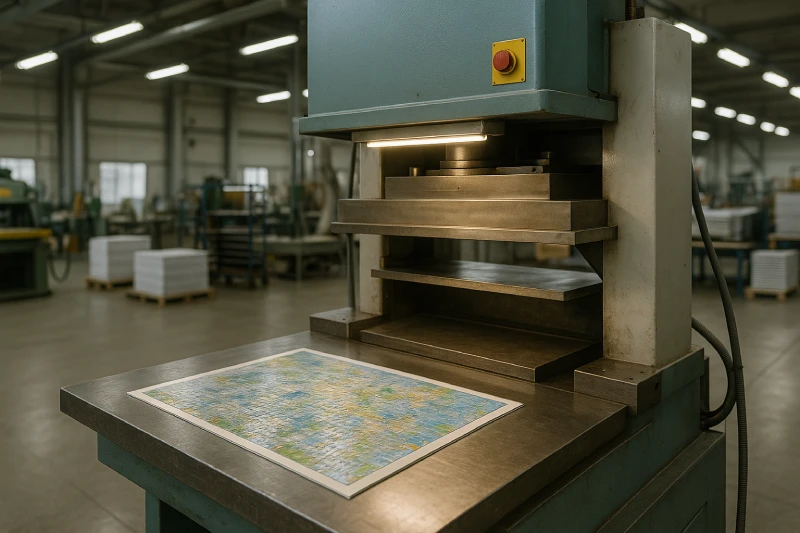
A professional puzzle press uses controlled hydraulic pressure to drive a steel-rule die through laminated sheets, creating thousands of perfectly shaped pieces in a single stroke. The engineering behind this process—platen flatness, tonnage calibration, die sharpness, rubber ejection rebound, sheet alignment—determines whether a production line can sustain high throughput without quality defects. Poor cutting performance leads to mis-registration, crushed edges, incomplete penetration, or excessive scrap, all of which increase production costs.
As global demand for higher-quality puzzles continues to rise, manufacturers increasingly invest in industrial-grade puzzle presses to stabilize output and achieve consistent precision across every batch. Understanding how the machine works is therefore essential for any factory planning to upgrade equipment or expand production capacity.
Core Components of a Puzzle Press
A puzzle press is an industrial die-cutting system engineered to deliver high, stable, and repeatable pressure across a steel-rule die. Its performance depends on several core mechanical assemblies working together with tight tolerances. Understanding these components helps manufacturers evaluate build quality, predict long-term reliability, and match machine specifications with their production goals.
Heavy-Duty Hydraulic System
The hydraulic system is the heart of a puzzle press. A high-capacity oil cylinder drives the upper platen downward with controlled tonnage—typically between 25 and 80 tons depending on die size and sheet thickness. Industrial machines integrate a proportional valve system to stabilize pressure throughout the cutting stroke, preventing fluctuations that can cause partial cuts or over-penetration. A well-designed hydraulic circuit also includes accumulator buffering, high-grade seals, and precision-machined cylinders to ensure consistent performance even under continuous multi-shift operation. This stability is essential for factories producing 1,000-piece puzzles where every blade must cut evenly across the full surface.
Upper Platen & Lower Worktable
Both platens must maintain excellent parallelism and structural rigidity. High-end puzzle presses use thick, heat-treated steel plates to minimize deflection during full-tonnage operation. Flatness tolerance is critical: even a slight deviation can produce inconsistent cuts along the die perimeter. The lower worktable often includes alignment slots or side guides to ensure precise sheet positioning.
Steel-Rule Die (Puzzle Cutting Die)
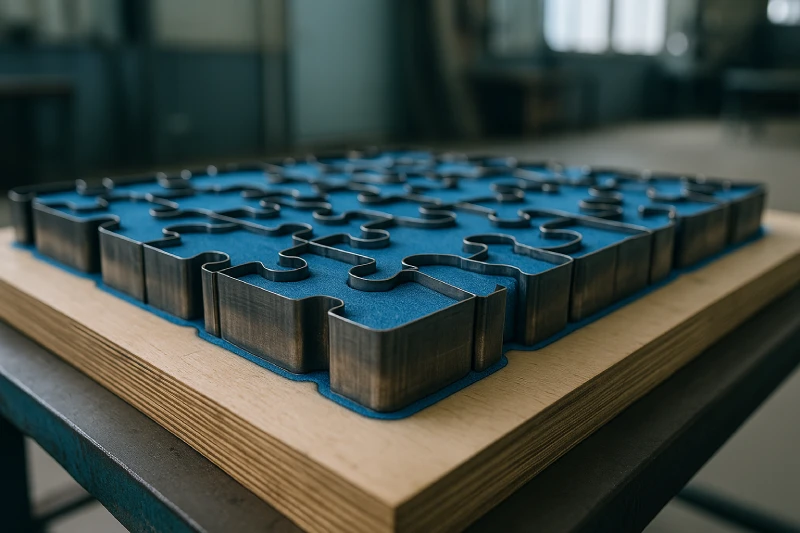
The die is the component that defines piece geometry. It consists of a laser-cut plywood board fitted with hardened steel blades—typically 0.45–0.71 mm thick—bent to form random jigsaw contours. Blueboard or ejection rubber surrounds the blades to prevent jamming and ensure clean release after each cut. The quality of the die directly affects interlocking accuracy, edge sharpness, and long-term durability. Professional factories frequently re-rule dies to maintain cutting integrity over long production runs.
Safety & Automation Modules
Modern puzzle presses integrate safety and productivity technologies such as two-hand controls, light-curtain guarding, emergency stop circuits, and semi-automatic feeding tables. Automation reduces operator fatigue, improves alignment accuracy, and increases hourly throughput—key advantages for large-scale puzzle manufacturers.
Pre-Cut Preparation — What Must Be Ready Before Pressing
Before a puzzle press begins its cutting cycle, several upstream conditions must be controlled to ensure clean edges, accurate interlocking shapes, and stable mass-production output. Proper pre-cut preparation reduces waste, minimizes machine adjustments during operation, and protects the cutting die from premature wear.
Laminated Puzzle Sheets
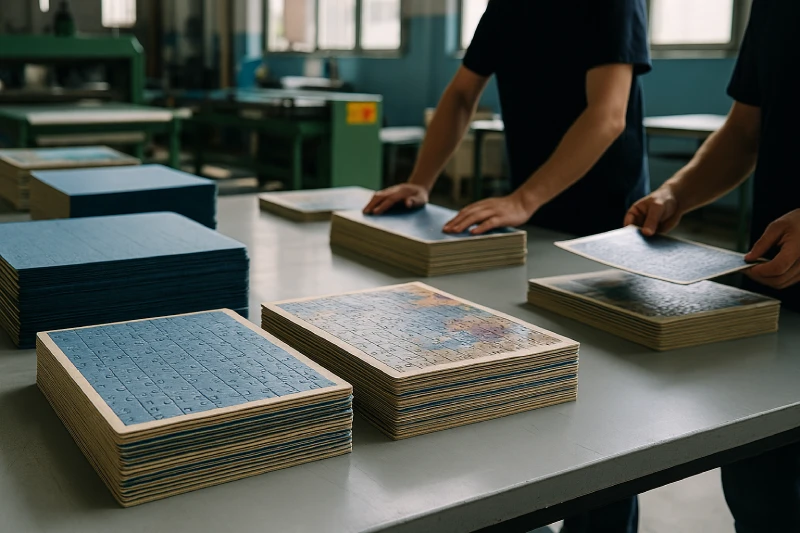
The laminated sheet is the material that will be die-cut into puzzle pieces, and its condition directly affects cutting performance. A typical sheet consists of a printed art layer mounted onto grayboard or blueboard with a final protective finish such as matte film, gloss film, or water-based varnish. Moisture control is critical; over-dry sheets may crack during compression, while over-humid sheets may deform or cause uneven blade penetration. Industrial factories maintain strict lamination pressure and glue uniformity to ensure the board remains flat without bubbles or delamination. Sheets are also trimmed to consistent dimensions so they match the die’s periphery, preventing misalignment during cutting.
Die Registration
Before production starts, technicians position the steel-rule die relative to the printed artwork. Microscopic deviations can cause piece outlines to fall outside intended contour lines, creating visual mismatch or customer complaints. Registration is typically performed through alignment pins, side guides, or laser positioning systems. A well-aligned die ensures both the aesthetic and mechanical accuracy of the final puzzle.
Pressure Calibration
Because puzzles vary in board thickness, coating type, and hardness, the hydraulic press must be calibrated before mass production. Technicians perform trial presses to determine optimal tonnage, blade penetration depth, and platen dwell time. Insufficient pressure causes incomplete cuts, while excessive pressure accelerates die wear and may crush the board surface. Proper calibration ensures each stroke fully penetrates all layers while maintaining a smooth, clean edge profile.
Step-by-Step: How a Puzzle Press Works During Cutting
The cutting cycle of a puzzle press is a precisely coordinated mechanical process. Each step influences the clean separation of pieces, die longevity, and overall production efficiency. Understanding this workflow is essential for manufacturers evaluating machine performance or optimizing their cutting line.
Step 1 — Sheet Positioning
The operator or automatic feeder places the laminated sheet onto the worktable, aligning it against side guides or mechanical stops. Accurate positioning ensures the printed imagery corresponds perfectly with the die’s blade pattern. Misalignment of even 1–2 mm can cause piece outlines to fall outside artwork boundaries. In semi-automatic systems, vacuum tables or alignment pins are used to keep the sheet stable during the downward stroke.
Step 2 — Die Engagement
When the cycle begins, the hydraulic cylinder drives the upper platen downward. The die, mounted to the platen or positioned on the worktable depending on machine design, makes initial contact with the sheet. The hydraulic system ramps pressure smoothly to avoid shock load that could distort the die board or damage blade edges. The result is a controlled penetration process where pressure distribution remains uniform across every blade, even on large 1,000-piece puzzle dies.
Step 3 — Full Penetration & Clean Punching
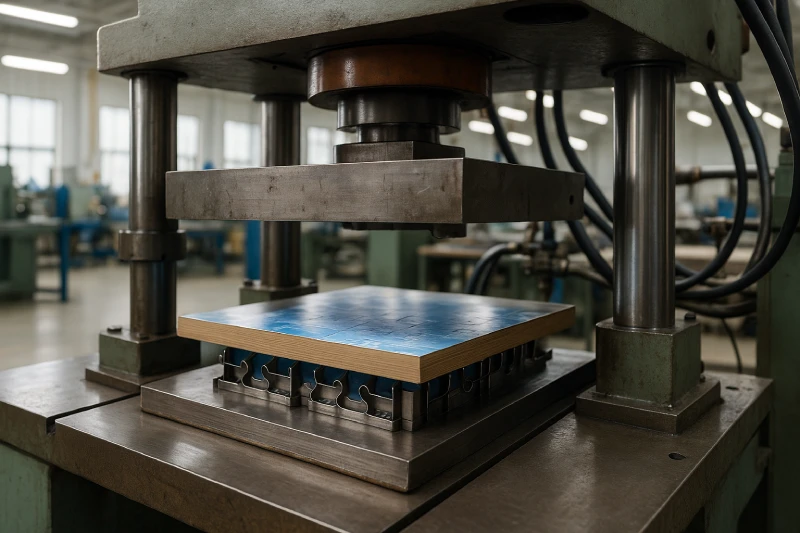
As tonnage reaches its calibrated value, the steel blades fully penetrate the laminated board. The blueboard or ejection rubber around the blades compresses downward and immediately rebounds, preventing the sheet from sticking to the die. Uniform penetration is crucial: insufficient pressure creates partial cuts that must be reworked, while excessive pressure can leave crushed edges or prematurely dull the blade. A well-engineered press maintains parallelism between the platens, ensuring consistent cutting depth across the entire sheet surface.
Step 4 — Pressure Release & Platen Return
Once the cut is complete, the hydraulic cylinder reverses, retracting the platen smoothly. This reduces stress on the die structure and minimizes noise and vibration. The sheet—now a fully cut puzzle—is lifted from the die either manually or by a conveyor, depending on the machine’s automation level.
Step 5 — Quality Inspection
Operators perform a quick inspection by flexing the sheet slightly to confirm that all pieces have separated cleanly. Edges are checked for tearing, over-crushing, or incomplete penetration. High-volume factories integrate inline inspection steps to ensure consistent quality over thousands of cycles per shift.
What Determines Cutting Quality in a Puzzle Press
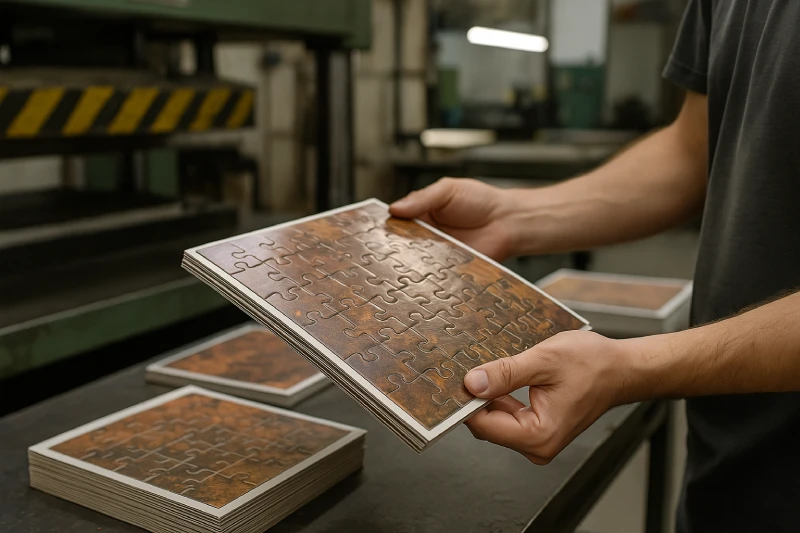
Cutting quality in puzzle manufacturing is the result of multiple mechanical, material, and operational factors working in alignment. A puzzle press does not operate in isolation; its output depends on the precision of the die, the stability of the hydraulic system, the condition of the laminated sheets, and the operator’s technical skill. Understanding these variables is essential for factories aiming to reduce scrap rates and improve overall yield.
Cutting Die Quality
The steel-rule die is responsible for defining the geometry, kerf width, and sharpness of every puzzle piece. High-quality dies use hardened steel blades with precise bending radii and consistent insertion depth. Inferior dies may exhibit inconsistent blade height, which leads to uneven penetration and fuzzy edges. The plywood base must resist warping to maintain cutting accuracy, and the blueboard rubber must provide consistent rebound force. Regular re-rule maintenance is required to keep blade edges sharp during long production runs.
Hydraulic Press Accuracy
A puzzle press must deliver stable pressure and perfect platen parallelism. If the tonnage fluctuates during the cutting stroke, some regions of the sheet may not fully penetrate. Likewise, a platen that deviates even 0.05–0.1 mm from parallel can create over-cut or under-cut zones. Industrial presses incorporate reinforced frames, heavy guide columns, and precision-machined hydraulic cylinders to maintain verticality and repeatability over millions of cycles.
Sheet Lamination Quality
The laminated board must be flat, evenly glued, and properly cured. Surface bubbles, uneven adhesive coating, or moisture imbalance increase resistance against the blade and lead to partial cuts or delamination. A poorly laminated sheet also wears down the cutting die more quickly, raising operating costs.
Operator Skill
Experienced operators understand how to adjust pressure settings, detect early-stage die wear, and perform accurate registration. Even with an advanced machine, improper sheet placement or incorrect tonnage can compromise cutting quality. Skilled technicians ensure consistent output and minimize rework.
Types of Puzzle Presses Used in Industrial Production
Puzzle manufacturers choose different types of presses based on their production scale, labor strategy, and desired cutting precision. While all machines rely on hydraulic force to drive a steel-rule die, the automation level and structural design vary significantly. Understanding these categories helps factories select the most cost-effective and reliable equipment for their workflow.
Manual Hydraulic Puzzle Press
A manual hydraulic press is the entry-level option for small workshops or low-volume production. Operators manually position sheets, activate the cutting cycle, and unload finished boards. While these presses are simple, affordable, and easy to maintain, they offer slower throughput and higher dependency on operator skill. Manual systems are most suitable for custom puzzles, prototyping, or businesses with limited daily output requirements.
Semi-Automatic Puzzle Cutting Machine
Semi-automatic presses introduce feeding assistants, alignment tables, and improved safety systems such as light curtains and two-hand controls. These machines significantly increase hourly productivity and reduce misalignment errors caused by manual handling. The semi-automatic design is favored by mid-sized factories producing 500–3,000 sheets per day, as it offers a strong balance of efficiency, precision, and investment cost.
Fully Automatic Puzzle Cutting Line
A fully automated production line incorporates automatic sheet feeding, die-cutting, waste separation, and conveyor-based unloading. This configuration minimizes labor input and ensures consistent alignment and pressure throughout long production shifts. Automation improves yield rate, lowers per-unit labor cost, and enables the stable mass production required by premium puzzle brands. Factories aiming for 20,000–30,000 puzzles per day typically adopt this system to support large-scale, continuous output.
Productivity & Throughput Considerations
The productivity of a puzzle press directly influences a factory’s cost structure, delivery speed, and overall competitiveness. Manufacturers evaluating new equipment must understand not only the cutting precision but also how cycle time, maintenance needs, and yield rate impact daily output. A high-precision press delivers measurable benefits only when paired with stable throughput and minimal downtime.
Cycle Time Per Sheet
Cycle time depends on the machine’s tonnage, platen travel distance, die size, and automation level. For most commercial jigsaw puzzles, a typical cycle takes 8–15 seconds, including positioning, cutting, and unloading. Automated feeding systems significantly shorten the non-cutting portion of this cycle, allowing factories to maximize output per shift. Consistent cycle time across long production runs is also a key indicator of a well-engineered hydraulic system.
Maintenance Requirements
Routine maintenance is critical for protecting cutting quality and ensuring machine longevity. Operators must regularly inspect the die for blade wear, replace hydraulic oil at scheduled intervals, and check the parallelism of the platens. Preventive maintenance reduces unplanned downtime and maintains stable cutting performance, especially for factories operating the press across multiple shifts.
Yield Rate & Cost Efficiency
Yield rate defines how many sheets are successfully cut without defects. A press with strong structural rigidity and stable hydraulic output reduces scrap caused by incomplete cuts or crushed edges. Higher yield translates directly into lower material loss, longer die lifespan, and improved per-unit cost efficiency. For high-volume manufacturers, even a 1–2% increase in yield can significantly impact profitability.
When Should a Factory Upgrade Its Puzzle Press?
Manufacturers typically consider upgrading their puzzle press when their existing equipment can no longer support required output, quality consistency, or operational efficiency. As production volumes increase, older presses may struggle to maintain platen parallelism, stable hydraulic pressure, or precise alignment across larger dies used for 500–1,000-piece puzzles. These limitations lead to higher scrap rates, frequent rework, and excessive die wear—directly increasing production costs.
Factories expanding from small-batch manufacturing to mass production also require faster cycle times and improved automation features. Upgrading becomes essential when labor dependency becomes a bottleneck or when customers begin demanding premium-grade puzzles with tighter tolerances and cleaner edges. Investing in a modern press ensures stable, repeatable performance and positions the factory for long-term growth and competitiveness.
How to Choose the Right Puzzle Press for Your Production
Selecting the correct puzzle press is a strategic decision that determines cutting quality, production capacity, operating cost, and long-term equipment stability. Because each factory has unique product sizes, board specifications, and workflow requirements, evaluating the right set of machine parameters is essential before making an investment.
Key Factors
Tonnage Capacity
The required pressing force depends on board hardness, thickness, and die size. Standard jigsaw puzzles typically require 25–80 tons, while oversized or thick specialty puzzles may demand higher capacity to ensure full penetration across the entire surface.
Platen Size and Structural Rigidity
The platen must accommodate your largest die with adequate margin. Industrial presses use reinforced frames and precision-machined platens to maintain parallelism—a critical factor for clean, uniform cuts.
Compatibility with Existing Dies
Factories with existing steel-rule dies must ensure the new press supports their mounting method, die height, and operating stroke.
Automation Level
Manual, semi-automatic, and fully automatic lines differ substantially in labor requirements and daily throughput. Automation becomes essential when aiming for consistent alignment and high-volume output.
Safety Standards
Light curtains, two-hand controls, emergency shutoffs, and CE-compliant electrical systems protect both operators and uptime.
Supplier Evaluation Checklist
When comparing manufacturers, consider build quality, hydraulic system reliability, electrical component brands, and long-term service capability. A strong supplier should provide die compatibility guidance, installation support, training for operators, and readily available spare parts. Customized configurations—such as reinforced platens or automatic feeders—are also valuable for factories planning rapid capacity expansion.
Conclusion — Investing in a Professional Puzzle Press for Higher Output
A high-precision puzzle press is more than a cutting machine—it is a core production asset that determines product quality, operational stability, and long-term manufacturing efficiency. From the hydraulic system and platen design to die accuracy and automation level, every engineering detail directly influences yield rate and overall production cost. For factories expanding capacity or targeting premium puzzle markets, upgrading to a modern press delivers immediate benefits: faster throughput, cleaner cuts, reduced waste, and more consistent interlocking performance across every batch.
As global demand for high-quality puzzles continues to grow, manufacturers equipped with reliable, industrial-grade cutting systems will outperform competitors in both efficiency and product consistency. If your factory is evaluating an equipment upgrade or planning a new production line, our technical team can provide customized machine specifications, die-matching guidance, and full production-line solutions tailored to your output goals.