
What Is a Puzzle Cutting Machine?
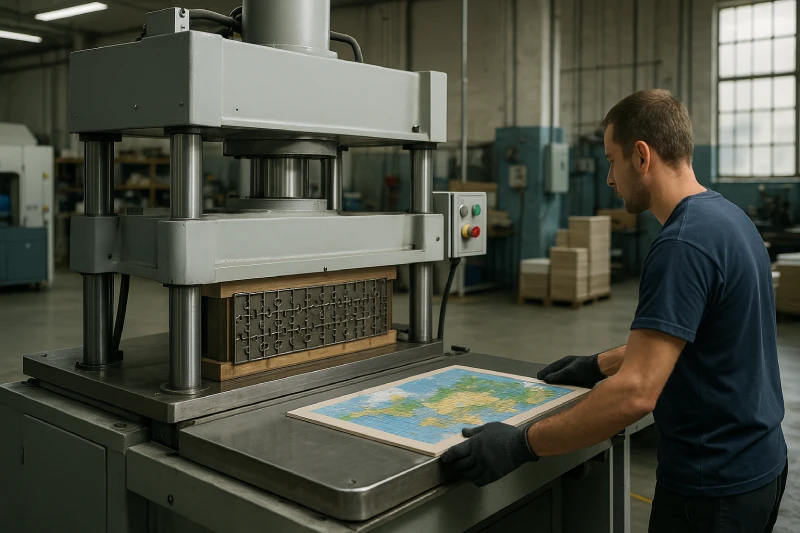
A puzzle cutting machine is an industrial die-cutting press designed specifically for producing jigsaw puzzles at scale. Unlike general-purpose flatbed die cutters, a puzzle cutting machine delivers the high pressure, precision alignment, and cutting stability required to form thousands of interlocking puzzle pieces with clean edges and consistent tolerances. It is a core workstation in every commercial puzzle manufacturing line and operates immediately after the printing and lamination processes.
In a standard workflow, printed and laminated sheets are transferred to the cutting station, where a steel-rule puzzle die—featuring hundreds or thousands of uniquely bent blades—cuts through the board in a single stroke. The accuracy of the machine directly determines the interlocking feel, the edge quality, and the overall consumer perception of the puzzle.
Modern puzzle cutting machines are available in manual, semi-automatic, and fully automatic configurations. Tonnage typically ranges from 50 to 250 tons, enabling the machine to cut materials such as grayboard, blueboard, art-paper–laminated duplex board, plywood, and EVA foam. Whether a factory produces 500-piece children’s puzzles or large 2000-piece premium puzzles, the cutting machine defines the achievable production speed and overall product consistency.
For manufacturers, investing in a dedicated puzzle cutting machine is essential for achieving stable mass production, reducing defect rates, and ensuring compatibility with professional steel-rule puzzle dies.
How a Puzzle Cutting Machine Works
A puzzle cutting machine operates on a high-pressure flatbed die-cutting principle: a hydraulic cylinder drives the upper platen downward, forcing a steel-rule puzzle die to penetrate the laminated cardboard sheet in a single controlled stroke.
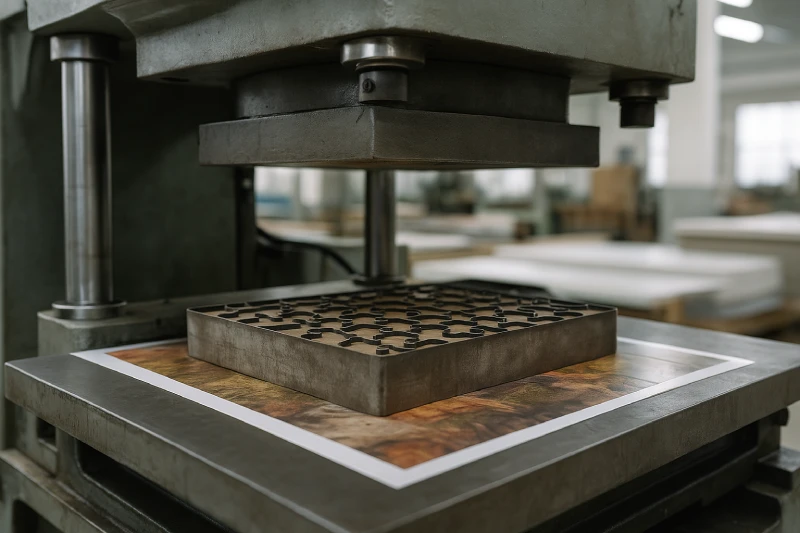
The machine’s stability, pressure accuracy, and platen parallelism directly determine cutting consistency and puzzle fit. Below is a breakdown of the core mechanisms behind the process.
Hydraulic Pressure System
The hydraulic unit is the power source of the cutting machine. A high-capacity oil cylinder—typically rated between 50 and 250 tons—generates uniform downward force to ensure every blade on the die enters the board evenly. The system includes a hydraulic pump, solenoid valves, pressure regulators, and an accumulator to maintain stable flow and rapid response.
Consistent hydraulic pressure prevents incomplete cuts, reduces burrs on the puzzle edges, and protects the die board from stress deformation. In modern semi-automatic and fully automatic machines, pressure, dwell time, and stroke are precisely controlled via PLC to achieve repeatable performance during continuous production.
Puzzle Die Structure During Cutting
The puzzle die is a CNC-routed die board embedded with steel-rule blades bent into interlocking puzzle shapes. Blade height (23.8–25.4 mm) and thickness (0.45–0.71 mm) determine cutting depth and durability.
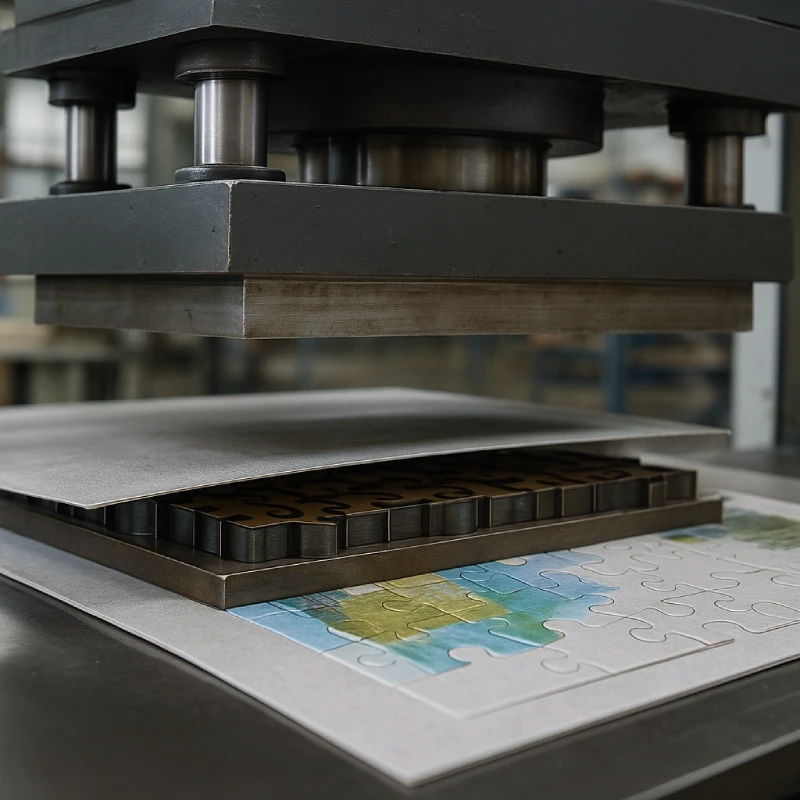
During cutting, every blade must penetrate the board evenly; therefore, die flatness and the machine’s platen parallelism are critical. Random-cut dies require even higher precision because the blade geometry is non-repetitive. When pressure is applied, the board separates cleanly along the blade edge, forming hundreds or thousands of accurate puzzle pieces.
Transmission & Control System
The transmission system controls the movement of the upper platen and feeding table. Manual models rely on simple hydraulic actuation, while semi-automatic and automatic machines integrate servo-driven tables, guided rails, stroke sensors, and PLC logic.
The control system manages cutting stroke, speed, pressure, and safety interlocks. This ensures smooth cutting cycles, reduced operator error, and long-term consistency in high-volume puzzle production.
Key Components of a Puzzle Cutting Machine
A puzzle cutting machine is engineered for precision, stability, and long-duration industrial operation. Its performance depends on the quality and configuration of several critical components. Each part contributes to cutting accuracy, die longevity, and overall production efficiency.
1. Steel-Rule Puzzle Die
The puzzle die is the heart of the cutting system. It consists of a CNC-milled wooden or composite die board fitted with steel-rule blades. Blade height typically ranges from 23.8–25.4 mm, while blade thickness varies from 0.45–0.71 mm, depending on puzzle size and material thickness.
The die must maintain perfect flatness and blade alignment; even a 0.1 mm deviation can affect interlocking accuracy or cause incomplete cuts. Premium dies use high-precision CNC routing and laser bending to ensure uniform edge geometry.
2. Hydraulic System
The hydraulic unit provides the force required for one-stroke cutting. It includes:
- Hydraulic pump
- Oil cylinder
- Pressure valves and regulators
- Accumulator or pressure stabilizer
- Cooling and filtration system
A stable hydraulic system prevents pressure spikes that can damage the die or produce inconsistent cutting depth. Heavy-duty puzzle presses use reinforced cylinders designed for long-term continuous operation.
3. Upper Platen & Worktable
The platen must maintain parallelism across the entire cutting area to ensure every blade engages the material evenly. Worktable sizes vary from 600×900 mm to 1100×1600 mm, depending on puzzle format.
High-rigidity structures and precision guide columns reduce lateral movement and enhance accuracy during repeated cycles.
4. PLC Control & Electronics
Modern puzzle cutting machines integrate touchscreen PLC interfaces for:
- Stroke control
- Pressure adjustment
- Cycle counting
- Automatic feeding (in automatic models)
- Fault diagnostics
Servo motors and sensors enable smooth table movement and consistent cutting timing.
5. Safety & Protection Systems
Industrial safety systems include two-hand controls, emergency stops, pressure relief valves, and light-curtain barriers. These mechanisms prevent accidental activation during die installation, sheet loading, or maintenance.
Technical Specifications
Puzzle cutting machines vary in tonnage, table size, and automation level, but most industrial presses share a common set of technical parameters. These specifications determine the type of puzzles a factory can produce, the achievable accuracy, and the daily output capacity.
Typical Puzzle Cutting Machine Specifications
| Specification | Typical Range / Value | Description |
|---|---|---|
| Cutting Force | 50–250 tons | Determines ability to cut thick grayboard, wood, and EVA. |
| Max Sheet Size | 600×900 mm to 1100×1600 mm | Defines the largest puzzle format supported. |
| Compatible Puzzle Size | 24–2000 pieces | Depends on die layout and board thickness. |
| Cutting Accuracy | ±0.1–0.2 mm | Critical for maintaining interlocking quality. |
| Productivity | 600–900 sheets/hour | Varies by automation level and operator skill. |
| Stroke Height | 50–260 mm adjustable | Controls platen travel distance for different die heights. |
| Power Consumption | 4–9 kW | Depends on pump size and automation system. |
| Machine Footprint | 1.2–3.5 m² | Important for factory layout planning. |
These specifications help determine which machine model best matches a factory’s required puzzle sizes, materials, and output volume.
Puzzle Cutting Machine Types
Puzzle cutting machines are available in three main configurations, each designed for different production volumes, labor requirements, and automation needs. Understanding these differences helps manufacturers choose the most suitable model for their factory.
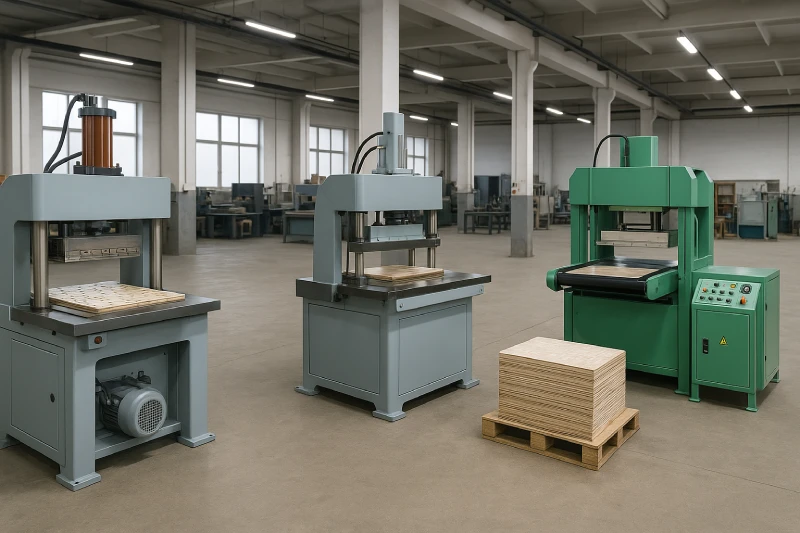
Manual Puzzle Cutting Machine
Manual puzzle presses are compact hydraulic machines operated through two-hand safety buttons. They provide cutting forces from 50–80 tons and are ideal for low-volume production, prototyping, or specialty puzzle formats.
They require the operator to manually position sheets and handle die changes, resulting in slower cycle times—typically 200–300 sheets/hour.
The advantage lies in low investment cost and simple maintenance, though they are not suited for high-throughput commercial puzzle factories.
Semi-Automatic Puzzle Cutting Machine
Semi-automatic machines represent the most widely used configuration in commercial puzzle plants. They integrate PLC stroke control, automated pressure adjustment, and sliding worktables or movable feeding trays.
Operators load sheets onto the tray, which slides into the cutting area; the machine then performs the cutting stroke automatically.
Productivity reaches 500–700 sheets/hour, with better accuracy and reduced operator fatigue.
This category balances speed, cost, and reliability—making it an excellent choice for medium-size puzzle manufacturers producing 500–2000-piece puzzles daily.
Fully Automatic Puzzle Cutting Machine
Fully automatic cutting systems eliminate most manual handling. They include auto-feeding conveyors, automatic sheet alignment, continuous die-cutting, and automatic ejection of cut sheets.
These machines achieve 700–900+ sheets/hour with minimal labor involvement. Accuracy remains highly consistent due to servo-driven feeds and stable hydraulic pressure.
They are the preferred solution for large puzzle factories targeting high-volume output, long production runs, and strict quality requirements.
Comparison Summary
- Manual: Lowest cost, lowest speed, suitable for small workshops.
- Semi-Auto: Best cost–performance ratio, stable accuracy, ideal for most puzzle factories.
- Fully Auto: Highest speed and efficiency, optimal for mass manufacturing.
Production Capacity
The production capacity of a puzzle cutting machine depends on its automation level, table size, die layout, and the material being processed. In commercial manufacturing environments, most semi-automatic and fully automatic puzzle presses operate at 600–900 cutting cycles per hour, though real output also varies based on operator efficiency and downstream processes such as sorting and counting.
For standard cardboard puzzles, a single cycle cuts one full sheet containing the entire puzzle layout. A 500-piece puzzle typically fits on a 500×700 mm sheet, while a standard 1000-piece puzzle fits on a 700×1000 mm sheet. With a semi-automatic press, factories commonly achieve 8,000–12,000 puzzles per 8-hour shift, assuming stable feeding and quick die changes.
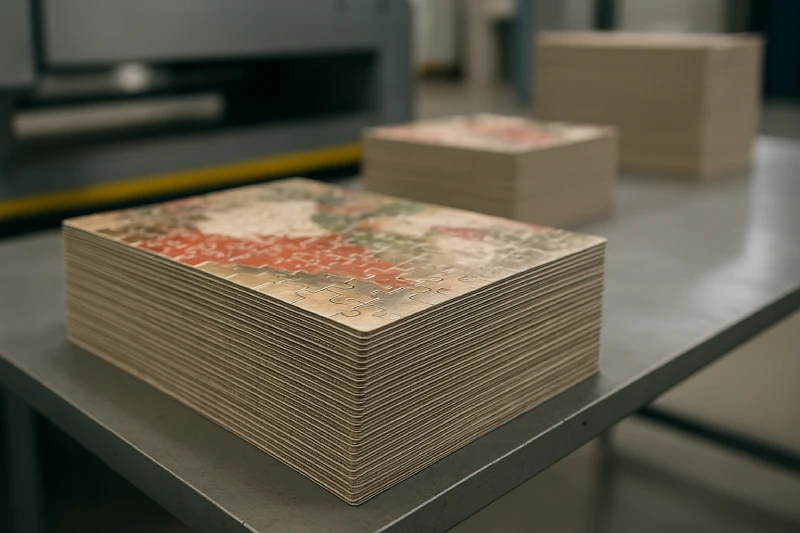
Cutting thicker materials such as plywood or EVA requires higher pressure and slower cycles. For wooden puzzles, production rates may drop to 150–250 sheets/hour depending on thickness and die configuration. Large-format puzzles (1500–2000 pieces) also require longer dwell time and more precise platen control, slightly reducing cycle speed.
Ultimately, a factory’s true daily output is determined by how well the cutting machine integrates with printing, lamination, sorting, and packaging. For continuous mass production, fully automatic puzzle cutting machines provide the most stable and predictable throughput.
Supported Materials
A puzzle cutting machine must generate sufficient and evenly distributed pressure to cut through a wide range of substrates used in commercial puzzle production. The choice of material affects required tonnage, die configuration, and achievable cutting quality. Below are the materials most commonly processed on professional puzzle presses.
Grayboard (1.5–2.5 mm)
Grayboard is the most widely used puzzle substrate due to its stiffness and excellent die-cutting performance. Machines in the 80–150 ton range can cut grayboard cleanly after lamination with art paper. Proper pressure settings prevent edge burrs and internal cracking.
Blueboard (Premium Puzzle Board)
Blueboard offers improved elasticity and chip resistance, making it ideal for premium puzzles. It requires consistent pressure and a sharp, high-quality steel-rule die to maintain clean interlocking edges. Accuracy tolerance is typically ±0.1–0.2 mm.
Laminated Duplex Board
Printed art paper laminated onto duplex board is common in children’s puzzles and promotional puzzles. Because laminated surfaces resist blade penetration, the press must maintain stable pressure throughout the stroke to avoid delamination or film cracking.
Wood (Plywood 3–5 mm)
Wooden puzzles require higher cutting force—often 150–250 tons—and reinforced dies with thicker blades (0.71 mm). Cutting speed is slower compared with cardboard substrates.
EVA Foam & Soft Materials
EVA puzzles used in early education products cut easily but require a die with lower blade height and a reduced pressure setting to avoid over-penetration.
The machine’s ability to support multiple materials makes it suitable for manufacturers targeting both mass-market and premium puzzle product lines.
Advantages vs Other Cutting Methods
Puzzle cutting machines are engineered specifically for producing interlocking jigsaw puzzles at industrial scale. Compared with alternative cutting technologies, professional puzzle presses deliver superior accuracy, efficiency, and long-term cutting stability. Below are the main differences.
Puzzle Cutting Machine vs Laser Cutting
Laser cutting is suitable for prototypes or low-volume customization, but it is not ideal for commercial puzzle production.
Key disadvantages of laser cutting include:
- Slow processing speed — cutting piece-by-piece dramatically limits throughput.
- Burn marks and discoloration on cardboard edges, especially on laminated surfaces.
- Lack of natural interlock shaping, which depends on the geometry of steel-rule blades.
In contrast, a puzzle cutting machine cuts the entire puzzle in a single stroke, producing clean edges without thermal damage and supporting mass production at 600–900 sheets/hour.
Puzzle Cutting Machine vs General-Purpose Die Cutting Press
Conventional die cutters lack the platen parallelism, pressure stability, and structural rigidity required for intricate puzzle dies. When applied to puzzle production, they commonly produce:
- Uneven penetration
- Poor interlock accuracy
- Higher die wear
- Increased rejection rates
Professional puzzle presses are reinforced to deliver uniform cutting depth across hundreds or thousands of blades simultaneously, achieving ±0.1–0.2 mm accuracy.
For factories producing 500–2000-piece puzzles, a dedicated puzzle cutting machine provides unmatched consistency, speed, and quality—making it the only viable solution for commercial-scale manufacturing.
Maintenance & Safety
To maintain stable cutting performance and extend equipment lifespan, puzzle cutting machines require routine mechanical maintenance and strict operator safety procedures. Proper upkeep also protects the steel-rule die, ensures accurate interlocking edges, and reduces downtime in continuous production environments.
Mechanical Maintenance
Routine maintenance focuses on hydraulic integrity, platen alignment, and die protection.
Key tasks include:
- Hydraulic oil replacement every 6–12 months to maintain pressure stability.
- Filter and cooling system cleaning to prevent overheating and fluid contamination.
- Platen parallelism calibration, especially after extensive production cycles or die changes.
- Inspection of guide columns and sliding rails for wear that might affect stroke accuracy.
- Die surface cleaning to remove paper dust buildup that can reduce cutting penetration.
Well-maintained machines extend die life and help keep cutting tolerances within ±0.1–0.2 mm.
Safety Guidelines
Puzzle presses generate high pressure, making operator safety essential. Industrial safety measures include:
- Two-hand activation to prevent accidental triggering.
- Light curtain systems to stop the machine when hands enter the cutting zone.
- Emergency stop buttons and overload protection valves.
- Lockout procedures during die installation and maintenance.
- Mandatory operator training for stroke adjustment and pressure control.
Strict safety protocols ensure reliable long-term operation and protect both operators and equipment.
How to Choose the Right Puzzle Cutting Machine
Selecting the right puzzle cutting machine directly affects your factory’s production efficiency, material compatibility, maintenance cost, and long-term scalability. When evaluating equipment, manufacturers should assess the following engineering and operational factors to ensure the machine aligns with their puzzle formats and production targets.
Define Your Puzzle Size Range and Formats
Different puzzle sizes require different die layouts and table dimensions.
- 500–1000-piece puzzles: typically use 700×1000 mm sheets.
- 1500–2000-piece puzzles: require larger tables and higher tonnage.
Ensure the machine supports your largest required format.
Determine Required Daily Output
Your expected daily volume determines whether you need:
- Manual press: low volume, prototyping
- Semi-automatic press: medium-scale factories
- Fully automatic press: large factories with continuous production
Higher speeds also reduce per-unit labor cost.
Select Appropriate Pressure Tonnage
Tonnage depends on material thickness:
- 80–120 tons: standard cardboard puzzles
- 150–250 tons: wooden puzzles or thick EVA
Underpowered presses cause incomplete cuts and excessive die wear.
Check Die Compatibility and Stroke Adjustment
The machine should support standard 23.8–25.4 mm blade height dies. Look for adjustable stroke and fine pressure control to avoid die deformation.
Evaluate Automation Level & Factory Layout
Automatic feeding, sliding tables, and servo-driven systems improve consistency and reduce operator fatigue.
Check space constraints, electrical requirements, and accessibility for die changing.
Confirm After-Sales Support
Reliable suppliers provide installation guidance, operator training, spare parts, and die-making consultation—critical for new puzzle manufacturers.
Price Reference
The cost of a puzzle cutting machine varies depending on its pressure tonnage, table size, automation level, and control system configuration. While exact pricing may differ by manufacturer and region, the ranges below reflect common market values for industrial-grade puzzle presses.
Typical Machine Price Ranges
- Manual Puzzle Press (50–80 tons): USD 3,000–8,000
Suitable for low-volume production or prototyping. - Semi-Automatic Puzzle Cutting Machine (80–150 tons): USD 9,000–18,000
The most popular choice for commercial puzzle factories. - Fully Automatic Puzzle Cutting Line (100–250 tons): USD 22,000–48,000+
Includes servo feeding, auto alignment, and automatic waste ejection.
Puzzle Die Cost
A steel-rule puzzle die typically costs USD 150–450, depending on:
- Piece count
- Blade height and thickness
- Die board size
- Random-cut vs grid-cut complexity
Additional Costs to Consider
- International shipping and crate reinforcement
- Installation and operator training
- Spare parts, hydraulic oil, and maintenance kits
Investors should budget for dies, consumables, and operator training to achieve stable long-term production performance.
Conclusion: Who Should Invest?
A puzzle cutting machine is an essential asset for any business planning to produce jigsaw puzzles at commercial scale. It is ideal for:
- Puzzle manufacturing factories expanding into higher-volume or premium puzzle lines.
- Printing companies adding puzzle products to diversify revenue.
- Toy and educational product manufacturers requiring stable and accurate die cutting.
- Startups building complete puzzle production lines for B2B or private-label brands.
With the right tonnage, table size, and automation level, manufacturers can achieve consistent quality, reduce defect rates, and significantly increase daily output. Investing in a dedicated puzzle cutting machine ensures long-term reliability and competitiveness in the fast-growing puzzle market.
If you are planning to upgrade your puzzle production capacity or build a complete jigsaw puzzle manufacturing line, our engineering team can recommend the right cutting machine, tonnage, and die configuration for your needs. Contact us today to request a customized quotation.