
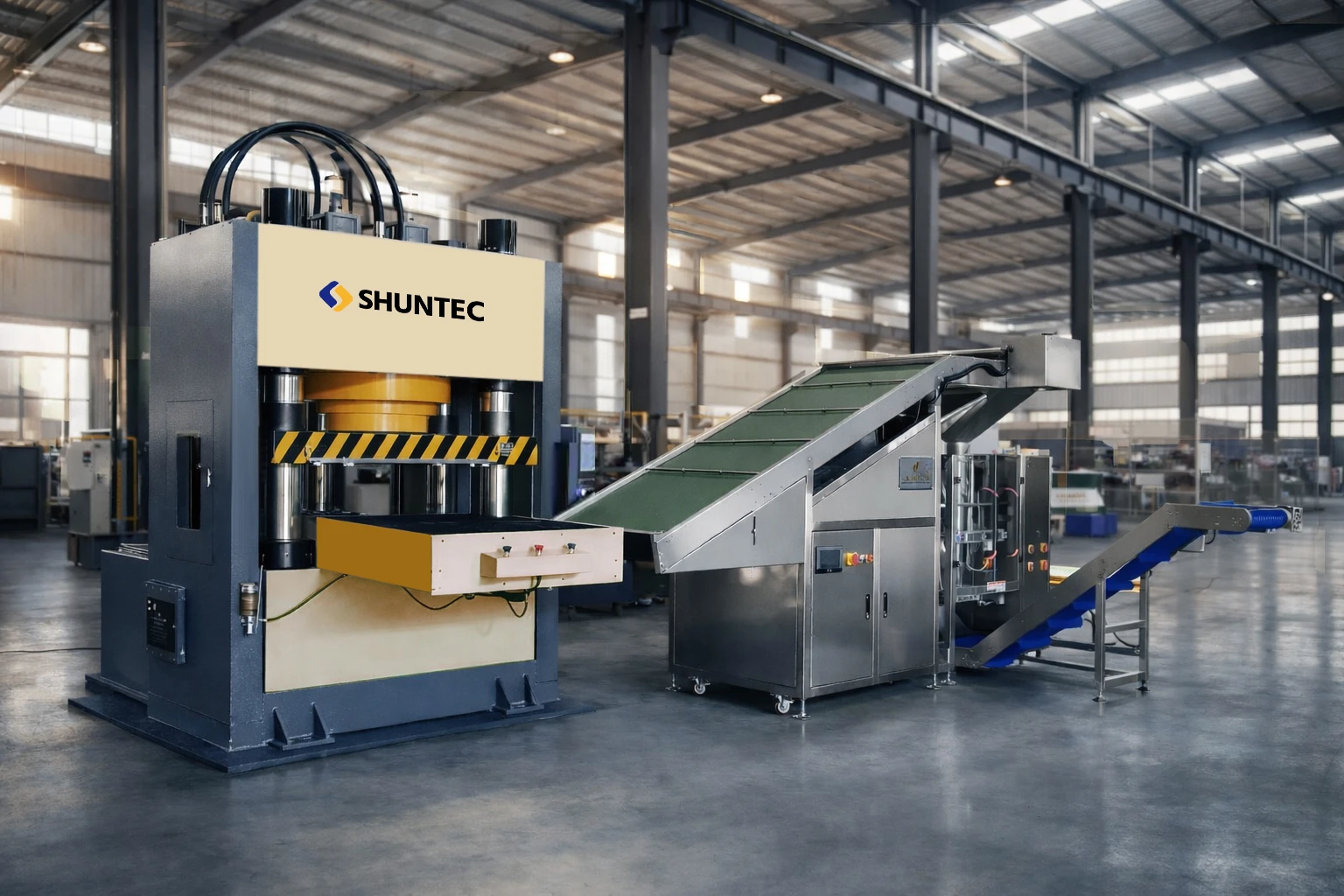
What Is A 4 Post Hydraulic Press?
A 4 post hydraulic press is a heavy-duty processing machine that generates sustained high pressure via hydraulic power. It handles metal stamping, forming, deep drawing, component press-fitting and composite moulding tasks. Built on a rigid four-column frame, the machine delivers stable operation and even load distribution, maintaining consistent parallelism between the moving ram and fixed worktable. Manufacturers across automotive, hardware, aerospace, home appliance and composite material sectors widely adopt this equipment. This document elaborates hydraulic circuit schematics by function, machine categories, practical applications and core technical strengths, offering clear reference for process engineers and factory procurement teams during equipment selection.
Definition of 4 Post Hydraulic Press
Also named four-column hydraulic press, this machine adopts a classic three-beam four-column structure consisting of an upper fixed beam, movable ram, bottom worktable and four precision ground guide columns. Operating under Pascal’s pressure principle, it converts hydraulic energy into controllable mechanical compression force. The high-integrity welded frame suffers minimal elastic deflection under full load, sustaining long-term machining accuracy and extending service life for both the press and matched tooling.
Core Operating Logic & Dedicated Hydraulic Circuit Diagrams
Single-acting hydraulic loop showing full oil circulation, pressure regulation and ram movement for general compression processes An electric motor drives a hydraulic pump to generate high-pressure fluid. Pressurised oil flows through manifold valves into the main cylinder, pushing the ram downward to complete forming. Once preset pressure hold time finishes, valve direction switches to feed oil into the rod cavity, lifting the ram back to standby position. This simple, low-failure circuit comes as standard on general-purpose four-post presses.
Dual-action hydraulic circuit fitted with blank holder cylinder to eliminate wrinkling during sheet drawing Deep drawing procedures require uniform clamping force to avoid material wrinkling. This separate hydraulic layout enables independent stepless adjustment of main compression force and blank holding force. During drawing cycles, the blank holder maintains constant clamping pressure while the main ram descends, effectively eliminating cracking and wrinkling defects on steel and aluminium alloy sheet parts.
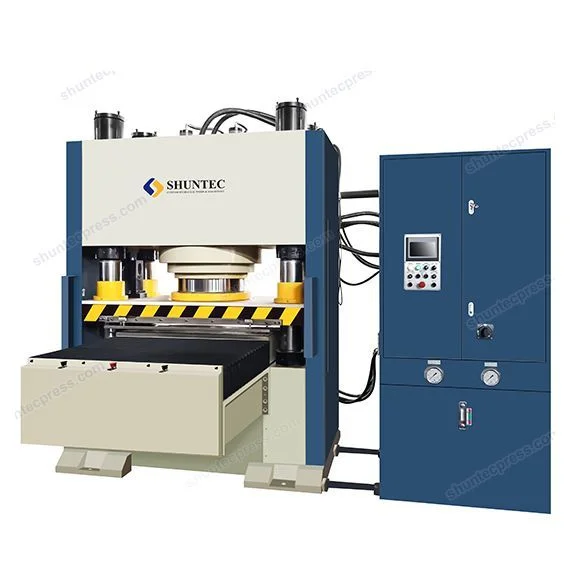
Independent hydraulic loop for bottom ejector, supporting automatic demoulding and reverse compression
Most four-post presses integrate an ejector cylinder beneath the worktable to eject finished workpieces post-forming. This diagram illustrates the dedicated oil supply circuit for ejection functions. Operators adjust ejecting force and travel distance via the touchscreen interface, significantly cutting cycle time for mass composite and hardware stamping production.
High-accuracy servo hydraulic circuit with real-time feedback for pressure, speed and position control High-end precision models equip energy-saving servo pumps and multi-point sensing modules. The schematic displays full closed-loop regulation logic. Compared with conventional fixed-displacement pump systems, servo hydraulic units consume less power, produce lower operational noise and achieve micron-level positioning accuracy, suitable for precision composite forming and automated production lines.
Combined safety hydraulic loop incorporating overload relief, emergency stop and safety gate interlock This circuit integrates pressure relief valves, travel limit sensors and emergency oil cut-off modules. When overpressure, ram over-travel, safety light curtain triggering or abnormal oil temperature occurs, the system instantly cuts hydraulic power supply. The design prevents structural damage and personal injury, fully complying with global industrial machinery safety standards.
Common Classifications of 4 Post Hydraulic Press
1.Standard General 4 Post Hydraulic Press
Suitable for sheet bending, contour forming and general component assembly for ordinary manufacturing workflows.
2.Dual-Action Deep Drawing 4 Post Hydraulic Press
Fitted with dedicated blank holding cylinders, mainly used for automotive body panels and home appliance shell deep drawing.
3.Servo Precision 4 Post Hydraulic Press
Features low noise and tight control tolerance, matching precision composite processing and automated assembly lines.
4.Specialised Hydraulic Press for Composite Moulding
Customised for hot compression of SMC, BMC, bakelite, carbon fibre and thermosetting plastic sheets.
5.Heavy-Duty Large-Tonnage 4 Post Hydraulic Press
Available in thousand-tonne grades, designed for forming high-strength aerospace plates and large automotive chassis components.
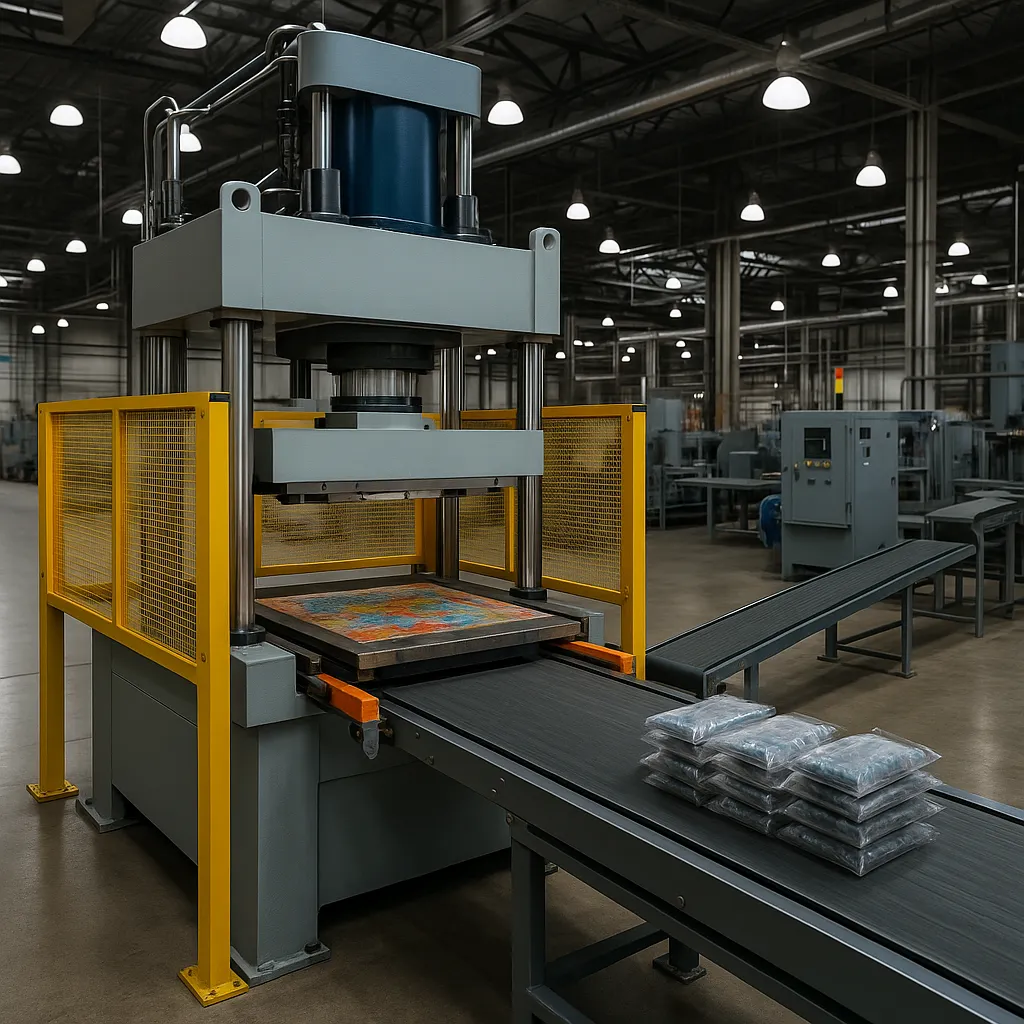
Core Technical Merits
- Four-column guided frame delivers high rigidity, even force distribution and reduced tool wear
- Fully adjustable compression pressure and ram speed to accommodate diverse forming processes
- Low running noise, moderate power consumption and straightforward daily maintenance
- Three operation modes (manual, semi-auto, full auto) for small-batch sampling and mass production
- Complete safety configuration including overload protection, safety light curtains and emergency stop buttons
- Customisable worktable dimension, ram stroke and nominal tonnage based on production requirements
Main Industrial Applications
- Metal processing: stamping, bending, deep drawing and extrusion forming
- Composite manufacturing: hot pressing of SMC, BMC, glass fibre and plastic materials
- Component assembly: bearing fitting, shaft press-fitting and hardware riveting
- Automotive production: body panels, chassis parts and interior component moulding
- Hardware & household appliance manufacturing: kitchen hardware and equipment shell stamping
- Aerospace sector: forming of high-tensile special alloy sheets
Key Factors for 4 Post Hydraulic Press Selection?
Production teams should evaluate the following parameters before purchasing:
- Required nominal tonnage (custom range: 10 ton to 10,000 ton)
- Worktable size, daylight opening and ram stroke to fit existing mould sets
- Target forming process: general pressing, deep drawing, precision moulding or part assembly
- Control system type: standard fixed pump unit or energy-efficient servo system
- Auxiliary demands for automated line connection and enhanced safety setups
Routine Maintenance Guidelines
- Fill the hydraulic tank with ISO VG46 anti-wear hydraulic oil, replace oil and filter elements on scheduled cycles
- Apply lubricating grease to guide columns and sliding bronze bushes at regular intervals to minimise abrasion
- Inspect oil seals, high-pressure hoses and valve block joints weekly to locate potential leakage points
- Avoid eccentric loading during processing to prevent permanent deformation of guide columns and piston rods